Feeds:
Posts
Comments

Food Deserts

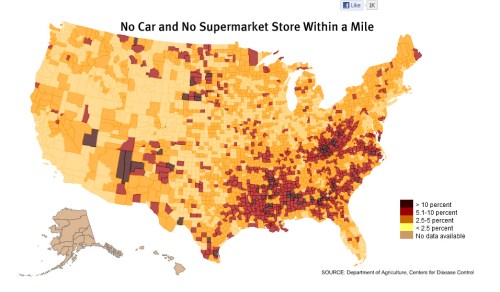
I discovered the graphic above in a recent Slate.com article by Chris Wilson, Dinner at the Kwik-E-Mart: Food Deserts in America.”

The Center for Disease Control and Prevention defines food deserts as “areas that lack access to affordable fruits, vegetables, whole grains, low-fat milk, and other foods that make up the full range of a healthy diet.”

One of the key lines of research and discussion that the SHP pursues is the degree to which “sustainable” methods can be measured. In fact, an important component of the working definition that we use includes the stipulation that “sustainability” must integrate methods of quantitative measurement, tracking, and evaluation.

U.S. Department of Agriculture provides a quantitative and accessible tool to evaluate food deserts in in specific counties throughout the country: The USDA’s Food Environment Atlas.

A student recently asked:

    How do we promote sustainable practices amongst people who don’t care about sustainability? Is it within our rights to force sustainable practices/actions on people who don’t care? Why do people who don’t care not care? Can they be changed? Should they be changed? (or is that infringe on their freedoms? Should we have that freedom?)

My response was that if we think of sustainability in terms of requiring democratic participation, forcing people to comply would run counter to this goal and be, therefore, unsustainable. However, has it ever been the case that 100% of the American population has gotten behind any initiative? The modern American democratic process regularly makes decisions that are supported by slim majorities of voters, and just five out of nine Supreme Court Justices can decide a case that will have repercussions for decades to come. Both of these outcomes take place within the American democratic process, but such majority decisions often results in a situation where quite a large number of people are put in a position of forced compliance with a policy or decision that they may not agree with. How does our working definition of sustainability account for this conundrum? Is it sufficient to our working definition to ensure that a process is in place that facilitates democratic participation, even if the outcome results in the dissatisfaction of a large minority of citizens (a minority that could potentially represent 49.9% of the population)?

Complexities abound as we probe these questions more deeply. If we attempt to specify these questions within a particular place, time, and situation, perhaps we might be able to discern some patterns about what causes people not to care about an issue someone else considers essential for sustainability. For example, do those who claim not to care have insufficient information about the topic? Are they being kept in the dark or being actively lied to? Do they have some kind of investment in or commitment to the status quo that they don’t want disturbed? Do they have an alternate definition of “sustainability” that isn’t being considered to their satisfaction?

[Post written by: Teddy Gautier & T. Smith]

It is important to remember that the need for sustainability arose from fears relating to present and future living standards, namely, but not limited to, depletion of vital natural resources, poverty, negative impacts on the environment, an anthropocentric view, and a general lack of understanding in terms of complex biospheric interactions. All of these fears or threats arise from human actions and interactions with and within their environment. As a result, any definition of sustainability should include the social requirements that need to be met as the core idea, and the environmental and economic aspects would be then be able to be accounted for. Also, that definition should let people know about the different steps that need to be followed in order to implement sustainable practices. The idea is not to propose a definition that is an absolute, thus making it near impossible to achieve, but rather to create a statement that is more practical and applicable to real life situations. Sustainability should be a conceptual framework that allows for amendments or changes to satisfy particular problems. The definition of sustainability that we are proposing will feature social sustainability as the primary focus, yet without understating the importance of the economic and environmental pillars.

Sustainability, as defined the Brundtland Commission and ubiquitously quoted, is: “Sustainable development is development that meets the needs of the present without compromising the ability of future generations to meet their own needs.” Following that definition is the key concept of “needs,” specifically the needs of the world’s poor and marginalized. When poverty is eradicated it should follow that the level of education throughout the world will grow immensely. It is very important that the value of education should not be understated. Positive democratic discourse and human well-being are direct corollaries of education and awareness. Education also provides means, solutions, upward mobility, and opportunity. When poverty is removed and social equity is established then economic and environmental challenges, in terms of sustainability, can be assessed and redressed with much greater ease.

Continue Reading »
[Post written by – Noah Sharpsteen, John Stephenson, Nigel Peltier, Daniel Gray]

Works Under Discussion:

The overarching discussion consists in the critique of the history and general concept of sustainability. Ricketts critiques sustainability by connecting it with radical movements in the 1960s and 1970s, comparing its general motivating influences to ‘catastrophe’ literature, recognizing the overly broad nature of the issues subsumed under the label ‘sustainability’ – stating that its inter-connected approach is “trivially true if true at all,” and ultimately locates its rationale in the sphere of a ‘religious’ dogmatism.[1] Bonevac critiques of a number of the definitions of sustainability used in contemporary practice.[2] The critiques range from stating that the definitions are too stringent and thus impossible to too weak and thus easily satisfied – even by the system in place today. The critique is sharp and insightful and provides a baseline both for further research into the definition (or purpose of a definition) of sustainability and also a model of critical approaches to sustainability in general. Rather than discuss the critical merits of Ricketts’ work, a work we feel to be awfully shallow, we believe that a discussion of Bonevac’s criticisms of the definition(s) of sustainability will prove more fruitful for developing an understanding and substantial critiques of sustainability in use today.

Bonevac established that the current definitions of sustainability are not theoretically possible to satisfy in an absolute sense. This notion of being absolutely possible to be satisfied is an important part of many of his criticisms. His idea of the definitions given are “all-or-none.” What is important to note, in our opinion, is that the definitions he gives – the ones actually given in the recent literature on sustainability – do demand the unsatisfiable criteria that Bonevac describes. We feel that his criticisms are important to understand, but they focus sharply on an issue that Bonevac misunderstands – namely, the apparently stringent criteria given by the definitions are focused on a different point. The motivation behind giving such definitions is not to set up absolute criteria, but to set up a framework for development, research, and improvement of the network of practices that have been labeled ‘sustainable.’ We believe that his criticisms stand as they are, but that has not ultimately stalled ‘sustainable’ practices and the efforts to further understand this concept and specify its ideological boundaries. This raises both an important question and important point. The question is, “What is the point of such a definition?” The point is that there is no common agreement that a definition of sustainability should have an idea of an ‘end-state’ or an eventual ultimate goal.

Continue Reading »

The proposed Oregon Sustainability Center (OSC) will be to the Living Building Challenge™ guidelines, “which would qualify it among the most sustainable buildings ever designed and constructed.” When it is built, it will be “home to Oregon’s leaders in sustainable business, government, and education. It will act as a laboratory for green technology regionally and globally, designed to be the greenest high-rise ever built—sourcing its materials locally, creating its own energy, and collecting and treating its water on-site” (Source).

The OSC will be built “on the eastern edge of Portland State University campus in downtown Portland, Oregon. It will form the nucleus of the Portland State University Ecodistrict, a neighborhood strategy to develop and integrate smart buildings, infrastructure, transportation, and community connectivity along sustainable lines” (Source).

Some people wonder if this project is worth the cost. Continue Reading »

Past Actions: Present Woes, Future Potential: Rethinking History in the Light of Anthropogenic Climate Change

    A model syllabus for historians and other students of the past to engage with issues of anthropogenic climate change through the medium of history and related disciplines. Developed by a small team associated with the Rescue!History network.

The Rescue!History network is a group of practitioners in the fields of humanities and social sciences who “wish to affirm that investigations and findings from our colleagues in the scientific community overwhelmingly support the conclusion that contemporary global warming is anthropogenic.” They assert that this climate change is a “spectre . . . haunting the entire world,” and cite the “unprecedented hurricane sequence in the Gulf of Mexico” in 2005 as evidence of “nature’s payback for what we are doing to our precious planet.” Rescue!History members lament humanity’s response to this evidence:
Continue Reading »

On Feb. 9, 2011, the Cascadia Green Building Council will feature Kath Williams speaking on “Opportunities in Eco-communities: People, Planet, and Profits”

    Globally the title “Eco-city” is used as a descriptor for every municipal project that is even the lightest shade of “green.” From newly constructed communities in China and Middle East to sustainable infrastructure projects in developed and developing nations, it is easy to bestow upon oneself the title. The questions becomes what are the motivations and what are the criteria? From lessons learned while working around the world, Kath Williams proposes all measurement tools should be framed in terms of values and opportunities for people, profit, and the planet if the goal of sustainability is ever to be achieved.

Williams is Principal of Kath Williams & Associates. She was Past president of the World Green Building Council and Executive Vice President of the International Institute for Sustainable Laboratories (I2SL).

The event will be held on Wednesday, Feb 9, 2011, at the Turnbull Open Space, White Stag Building, University of Oregon, 70 NW Couch St., Portland. Doors open at 5:00PM, lecture begins at 5:30PM Cascadia Members and students are free (RSVP mandatory), general audiences pay $10.

See the event announcement for more details.

The Illahee Lecture Series was founded in 1999 and is a program of the Portland-based non-profit Illahee Institute. The organization’s mission is to provide participants with “practical tools for understanding the nature of our home here in the Pacific Northwest, and for taking care of it. We provide the region opportunities for science-based, policy-relevant environmental inquiry.”

The group’s founders chose the Chinook word illahee, which describes “‘earth, ground, land, country, place or world.’ Unlike the word ‘environment’ that implies a separation, illahee conveys the all-encompassing relationship that ties the people of a place to the land and each other.” (Source)

One of Illahee’s ongoing questions has been: “Why is it so difficult for individuals, nations and the international community to address obvious issues like water needs, energy transition and climate change?” To address this question, their 2011 lectures center on the topic “Searching for Solutions: Innovation for Public Good.”

Upcoming lecture details and dates can be found here; archived lecture details and dates can be found here

There’s an intriguing documentary premier upcoming:

“The Greenest Building”

(A Wagging Tale Productions Documentary)

Monday, Jan. 31, 2011, 6:30 – 8:00 P.M.

The Gerding Theater at the Armory
128 NW Eleventh Ave., Portland

Movie description:

    Over the next 20 years, Americans will demolish one third of our existing building stock (over 82 billion square feet) in order to replace seemingly inefficient buildings with energy efficient “green” buildings.

    Is demolition in the name of sustainability really the best use of natural, social, and economic resources? Or, like the urban renewal programs of the 1960’s, will this well-intentioned planning result in devastating environmental and cultural consequences?

    Continue Reading »

Ellen Tarlin has recently started an online experiment at Slate.com to investigate some of the ways of thinking about food and nutrition at the individual and household level. She calls this project “Clean Plate: Outrageous Experiments in Sensible Eating.”

Tarlin’s experiment is quite accessible. She writes brief posts in a conversational style, and engages her readers in the comment threads. Among the pages on her blog are brief analyses of nutritional guidelines (i.e., the USDA food pyramid) and diet schemes, photos and prices of each item she’s eaten during the day, and questions to her readers about what she’s doing.

Tarlin’s project got me thinking about related initiatives, films, books, etc., on the topic of of food, food systems, and nutrition. Below the fold you’ll find a list of some of these other projects. The list is by no means exhaustive, so feel free to recommend others in the comments.

Continue Reading »